My partner Tony and I met in March of 2004 when I purchased a copy of Oasis’ Wibbling Rivalry from him on Ebay (he often jokes that I paid $10 plus shipping for him). It was one of those last minute decisions that changed my life forever. I was downstairs in my office, sitting at my computer, mindlessly scrolling on Ebay instead of editing photos (I was a professional photographer at the time). One of my best friends had recently been killed in a brutal car accident, and I was a bit untethered, questioning many things in my life. I had a husband and two small children and was trying to find my way when I thought I was losing it. Scrolling on Ebay was an escape.
At the time, I was a big fan of the band Oasis, so while searching for Oasis items, I happened upon a listing for the hilarious Wibbling Rivalry, a chaotic interview with the Gallagher brothers that was recorded about ten years earlier. I already had a burned copy of the CD that I had made myself, but figured since this one was the real deal, I’d go for it. I could tell by the description of the auction that the person who wrote it was from England, though they had a Tennessee location listed. I was intrigued.
Five minutes to go on the auction, I decided that I didn’t need the CD since I already had a copy. Three minutes to go and I decided that maybe I did want it. One minute to go and I was still on the fence. About ten seconds to go and I put in a bid and moments later, my life changed forever when I won the auction. It’s a modern-day fairytale beginning, though nothing ever works out like fairytales do.
Tony and I became fast friends, bonding over music. He was indeed originally from the north of England, but had lived in the States for 11 years, and was currently living in Tennessee with a woman and her three kids. We emailed back and forth for a while, used AOL’s Instant Messenger a bit, and let our lives unfold. Tony eventually moved in with a friend about two hours from where I lived, then was transferred to my city with his job in mid-2005. We remained friends through all of this, neither with any intention of a deeper relationship. As Tony put it, he was keeping his options open. For me, I was in the process of separating from my husband, and had no intention of jumping into a new relationship. But our friendship persisted and we knew that we would be in each others’ lives in some way.
There’s no definite point where I can say our friendship ended and our romantic relationship started. It’s really hard to pin down, though it occurred after both of our relationships had dissolved. When we shifted from friends into a steadfast partnership that would last a lifetime, I can’t really say and it doesn’t really matter. Twenty-two years on, and we’re still together.
We’ve had a great time on our journey, some definite bumps in the road, but it’s always been music that has held us together. We hosted a very popular local pop music quiz together for over 12 years, recorded an album of his original music together, and spent hours upon hours sharing our favorite songs and going to live shows of our favorite bands.
And now this…the final act of love.
In December of 2021, Tony was diagnosed with early-onset Alzheimer’s Disease, and our lives—in particular our future together—have been turned upside down. It was music that first brought us together, and music that first gave me a clue that something was wrong with Tony. He was not only forgetting things, but, more importantly, not processing information. We were watching a documentary on Pink Floyd’s David Gilmour, and a dark-haired woman appeared on screen.
“Who’s that?” Tony asked, not recognizing the woman.
“That’s Polly Samson, David’s wife,” I replied. “She is a writer, and has even written lyrics for many of Dave’s songs.”
“Oh,” he replied. “I didn’t know that.”
Five minutes pass, and Polly appears on screen again.
“Who’s that?” Tony asked again.
“Are you serious?” I asked, perplexed since I had just answered the same question. Maybe he was joking.
“Well, yeah,” Tony responded. “I don’t know who she is.”
“That’s Polly Samson. Dave’s wife,” I repeated. “I just told you that.”
“I don’t remember…”
I don’t remember. Now the most repeated three words in Tony’s vocabulary.
Tony was officially diagnosed with Alzheimer’s after a series of verbal testing. I didn’t trust any kind of verbal tests, because sometimes people get nervous and don’t answer questions well. I know I hate taking tests, and I figured it was the same for Tony. So I signed him up for a comprehensive memory study where they not only did verbal tests, but also tested for Amyloid Plaque and Tau Tangles, both indicators for increased risk of Alzheimer’s, and both present in Tony’s brain. Now in his fifth year of the study, his Amyloid and Tau levels have increased, and it has also been determined that he has two copies of the APOE4 genes (APOE4 homozygotes) one from his father, and one from his mother. His fate is sealed and any hope of this being “just forgetfulness” has gone.
We were lucky that the first three-and-a-half years of his diagnosis were pretty normal. He hung in the mild cognitive impairment phase (MCI) for that period of time and was able to continue working, keep driving, make his food for lunch, and do pretty much everything he always did. He would just forget things and repeat himself: tolerable, though sometimes frustrating for both of us.
In August of 2025, he was moved for a second time within his work. This time he was moved to a new building across town in an area that he was not familiar with, in a job he had never done before. He was expected to “just learn it” and get on with things, but that didn’t happen. For the month leading up to his new job transfer, he began to panic. He was constantly worried about it and how he would handle it. By the time the new job started, I had to drive him to work because he couldn’t follow directions on how to get there. On the first day, he met his new co-workers and we drove to his new job site (though training was at a different location). Right after we got home from going by the new site, he texted his co-worker to ask where the job site was, even though he had just been there and had spoken to the same co-worker in person. That worried me greatly, and the days that followed plummeted Tony into a new phase of his Alzheimer’s that eventually led to a panic attack and him having to go on short-term disability.
Now he is no longer working and will not be going back after his disability leave ends. He can no longer drive, and it was determined after testing that he is now in the moderate-to-severe stage of the disease. He cannot remember this diagnosis, nor anything about his disease. He still calls it “MCI” and often states that he doesn’t understand what is happening to him, though it has been explained by me and his doctors many times.
This is a cruel, ruthless disease. Though your body is often fine, your mind is deteriorating–literally shrinking–and not with any level of prediction. One hour of the day, Tony may seem quite normal, like his old self. The next hour, he is completely unaware of anything I am saying and doesn’t remember what he did five minutes earlier. Several weeks may go by with no noticeable changes, and on the fourth week he might deteriorate into yet a new level of dementia-madness.
The unpredictability of Alzheimer’s not only makes it difficult to prepare or plan for anything, but also keeps me–as his care partner–in a state of constant confusion and frustration. And it is isolating for both of us. I feel like there are few people in my circle who have a clue what is happening in my life, though I am well-supported by friends who I love dearly. When most of my friends or Tony’s friends see him, he is relatively normal to them, as Tony is brilliant at masking his disease. He has always been very chatty, and continues to be that way unless he is having difficulty following a conversation, then he is mostly silent. When he is chatty, people don’t see anything wrong with him, though he repeats himself sometimes. When he is quiet, they don’t have the opportunity to notice that anything is wrong, and once again, no one sees what I see. His friends in England don’t see too much of a change, since he is mostly typing to them on chats, and can be careful about what he says. Again, he repeats himself often, but they do not see (or receive) the frustration that I get from him. They do not see the agony of the disease in the same way as I do, nor do they understand the severity of it or how quickly he is declining.
In that, I feel alone.
As a therapist, I have led caregiver support groups before, and have worked with caregivers individually, but I have never been a participant in one until three weeks ago. I am now in a 10-week care partner support group, and it has helped me to feel seen in new ways. Though I often have to resist the urge to lead the group or share my knowledge, I am allowing myself to just settle into the role of participant. Though the other participants do not know exactly what I am going through (as no one can), I am with people who can relate to my experiences of frustration, grief, anger, and loneliness that Alzheimer’s brings.
If you are not in a support group and are a caregiver, I highly recommend finding one. Here are two links that may be helpful to you:
In peace and love,
Amanda
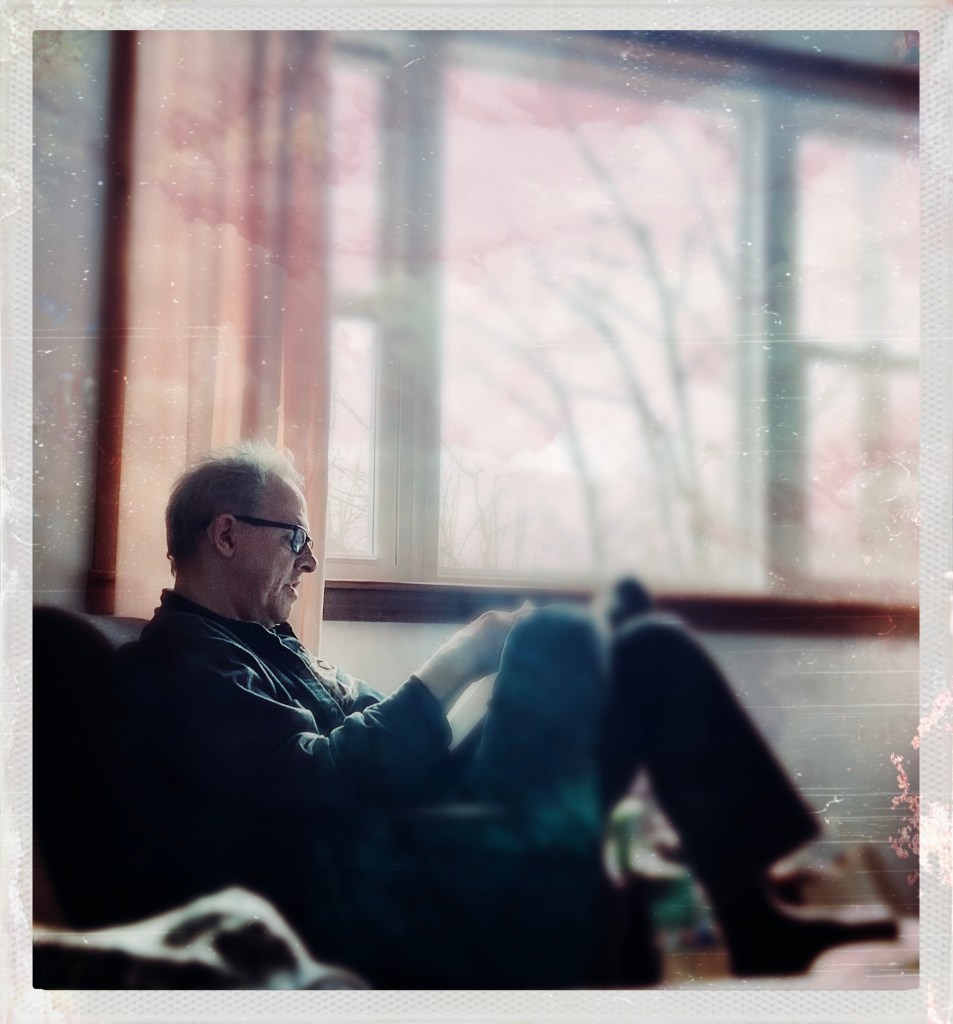
Tony, quietly reading in the mountains. 2023

 Somebody's Everything
Leave a comment